Charles Perkins had been extremely involved in the struggle for rights and freedoms of Aboriginal people. His personal connection with the issue, being Aboriginal himself, made his passion for the cause all the more powerful.
Student Action for Aborigines (SAFA)
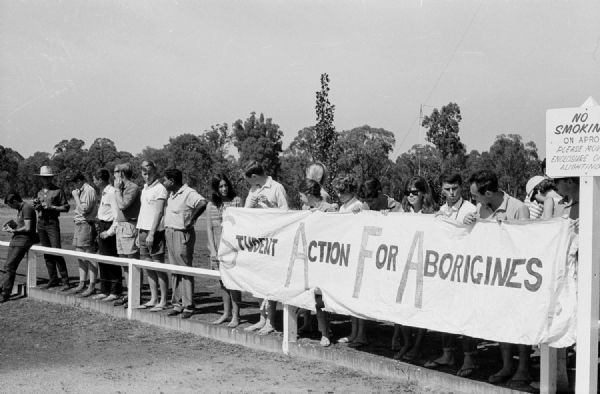
Student Action for Aborigines was formed in 1964 at the University of Sydney. This was a time where Australians were ignorant to the racism happening in their country, believing it was only taking place in South Africa and the southern states of the USA. The students came up with a plan of action and with Charles Perkins elected president, SAFA was formed and received the attention and members from a variety of existing student groups. In February 1965, SAFA hit headlines upon hiring a bus and setting off to some of the most racist towns in New South Wales on a 'Freedom Ride'.
Freedom Ride
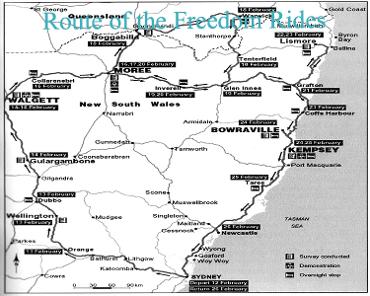
The Freedom Ride took place in 1965 across New South Wales as seen in the map below. The intention of the ride was to highlight and protest the mistreatment and discrimination of Aborigines in the country towns of Western New South Wales. Public places such as town halls, hotels and swimming pools were visited in places that were known for mistreating Aboriginals. Walgett was one of these places visited for their banning of Aboriginal service men that served in the World Wars from entering their local RSL. In Moree, Perkins and fellow students befriended indigenous students prevented from the public pools. Here was where he was nearly arrested for blocking the entry of the pool in protest, gaining significant media coverage. By the end of the trip, Charles Perkins was a national recognised figure among the fight for Indigenous rights.
"Today We Struggle For The Soul Of Our Country"
-Charles Perkins
"Sometimes found it difficult to observe the constraints usually imposed on permanent heads of departments because he had a burning passion for advancing the interests of his people"
-Australian ex-Prime Minister Bob Hawke in regards to Charles Perkins


His involvement as a Freedom Rider pushed him in the position of an Aboriginal leader and spokesman. He held his status until death.
In the post-referendum period, Charles was exceptionally critical of the Federal Council, as he believed they hadn't done enough to equalise power with Aboriginals.
Foundation for Aboriginal Affairs
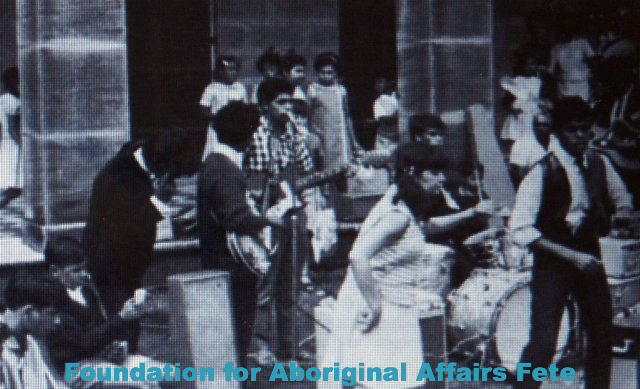
Charles Perkins, along with Ted Noffs, Bill Geddes, Ken Brindle and others worked together to established the Foundation for Aboriginal Affairs in Sydney. The establishment was designed to be a welcoming social centre that encouraged Indigenous persons to take control of their lives. With their self-help approach, it allowed them to make it in wider society. Following a massive fundraising campaign in 1964, the Foundation for Aboriginal Affairs was able to provide an array of facilities including: a gymnasium, counselling services, adult education, a hostel and short-term accommodation. Charles Perkins became the manager of the institution in 1965 and extended the help the foundation provided by speaking with businesses with the objective of finding work for keen Aboriginal men and women. This would provide them with a fundamental skill set to find further jobs of their own.
The Commonwealth Office of Aboriginal Affairs/Department of Aboriginal Affairs
The Office of Aboriginal Affairs was established by the Whitlam Government. The department was responsible for matters relating to Australian Aboriginals, developing and administrating national policies to advance and improve the welfare, as well as introducing special laws regarding Aboriginal people. In 1969, Charles Perkins joined the Commonwealth Office of Aboriginal Affairs and moved to Canberra to begin his work as a researcher. In 1984 he became Secretary of the Department and also the first Aboriginal Australian to head a Government department. Unlike most Government officials, Perkins continued his activist work and used his position to further his efforts despite public criticism for his own department making him a well-known controversial figure. In this position he spoke out on an international level about Australia being a racist country, in particular on his trip to London in 1975 where he "embarrassed Australia overseas". Forced to resign in 1988 due to a scandal involving the funding of an Aboriginal social club, he was later cleared of all charges.
Aboriginal and Torres Strait Islander Commission (ATSIC)
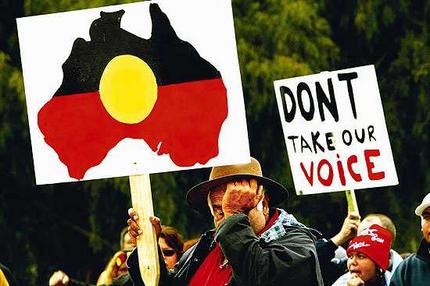
Returning to Alice Springs in his later years, he was elected in 1993 into the Aboriginal and Torres Strait Islander Commission (ATSIC). From 1994–1995, Charles Perkins served as Deputy Chairman of the ATSIC. The Aboriginal and Torres Strait Islander Commission was created by Bob Hawke's Labor government through the Aboriginal and Torres Strait Islander Commission Act 1989. This occurred while Charles was the head of the Department of Aboriginal Affairs and came into effect on the 5th of March, 1990. Through this, Indigenous Australians were formally involved in Government processes that would affect their lives resulting in effective communication among the States and Territories. The national voice received through this commission would allow improve results Indigenous Australians. While in these positions, Charles Perkins was one of these voices for the Indigenous community.
Arrernte Council of Central Australia
In 1989, Charles Perkins became a member of the Arrernte Council of Central Australia. The Arrernte Council is an Australian Aborigine council for the Arrernte people Central Australia. The council acts as a leader to the Indigenous community, promotes sustainable employment through its business division Arrernte Workforce Solutions, and encourages cultural identity and integrity.
Website References:
- Foundation for Aboriginal Affairs. Collaborating for Indigenous Rights. Retrieved 1 September 2016, from http://indigenousrights.net.au/organisations/pagination/foundation_for_aboriginal_affairs
- Freedom Ride, 1965. Collaborating for Indigenous Rights. Retrieved 1 September 2016, from http://indigenousrights.net.au/civil_rights/freedom_ride,_1965
- Sparks, K. (2000). Charles Nelson Perkins | Australian activist. Encyclopedia Britannica. Retrieved 1 September 2016, from https://www.britannica.com/biography/Charles-Nelson-Perkins
- Student Action for Aborigines. Collaborating for Indigenous Rights. Retrieved 1 September 2016, from http://indigenousrights.net.au/organisations/pagination/student_action_for_aborigines
- Charles Perkins. Collaborating for Indigenous Rights. Retrieved 28 August 2016, from http://indigenousrights.net.au/people/pagination/charles_perkins
Picture References:
- Tribune/SEARCH Foundation, Mitchell Library, State Library of New South Wales
- The Australian, 19 February 1965, p. 4
- 1965 'Freedom Ride'. The Koori History Website. Retrieved 27 August 2016, from http://www.kooriweb.org/foley/images/history/1960s/freedom/frdx.html
- Anthony, T. (2010). Learning from ATSIC. ABC News. Retrieved 25 August 2016, from http://www.abc.net.au/news/2010-01-06/27934
- Black Voice, Deaf Ears. (2004). The Sydney Morning Herald. Retrieved 2 September 2016, from http://www.smh.com.au/news/National/Black-voice-deaf-ears/2004/11/11/1100131136612.html
- Foundation for Aboriginal Affairs Fete. (2015). A History Of Aboriginal Sydney. Retrieved 2 September 2016, from http://www.historyofaboriginalsydney.edu.au/central/foundation-aboriginal-affairs-fete
- Gorman, J. (2015). Buried history: aboriginal leader Charles Perkins was a pioneering soccer star. The Sydney Morning Herald. Retrieved 1 September 2016, from http://www.smh.com.au/national/charles-perkins-soccer-star-20151015-gka0by.html
Video References:
-
Charles Perkins' 1965 Freedom Ride. (2014). Retrieved from https://www.youtube.com/watch?v=ou0KMWmpmPE
By Jasmine Wormleaton.
